Edge AI: Edge Computing and Intelligence
Edge AI is giving a device its own "brain" so it can think for itself, right where it is, instead of asking a giant supercomputer far away for every decision.
Billions of data is generated at network edge; every day. AI apps are thriving with strong demand.
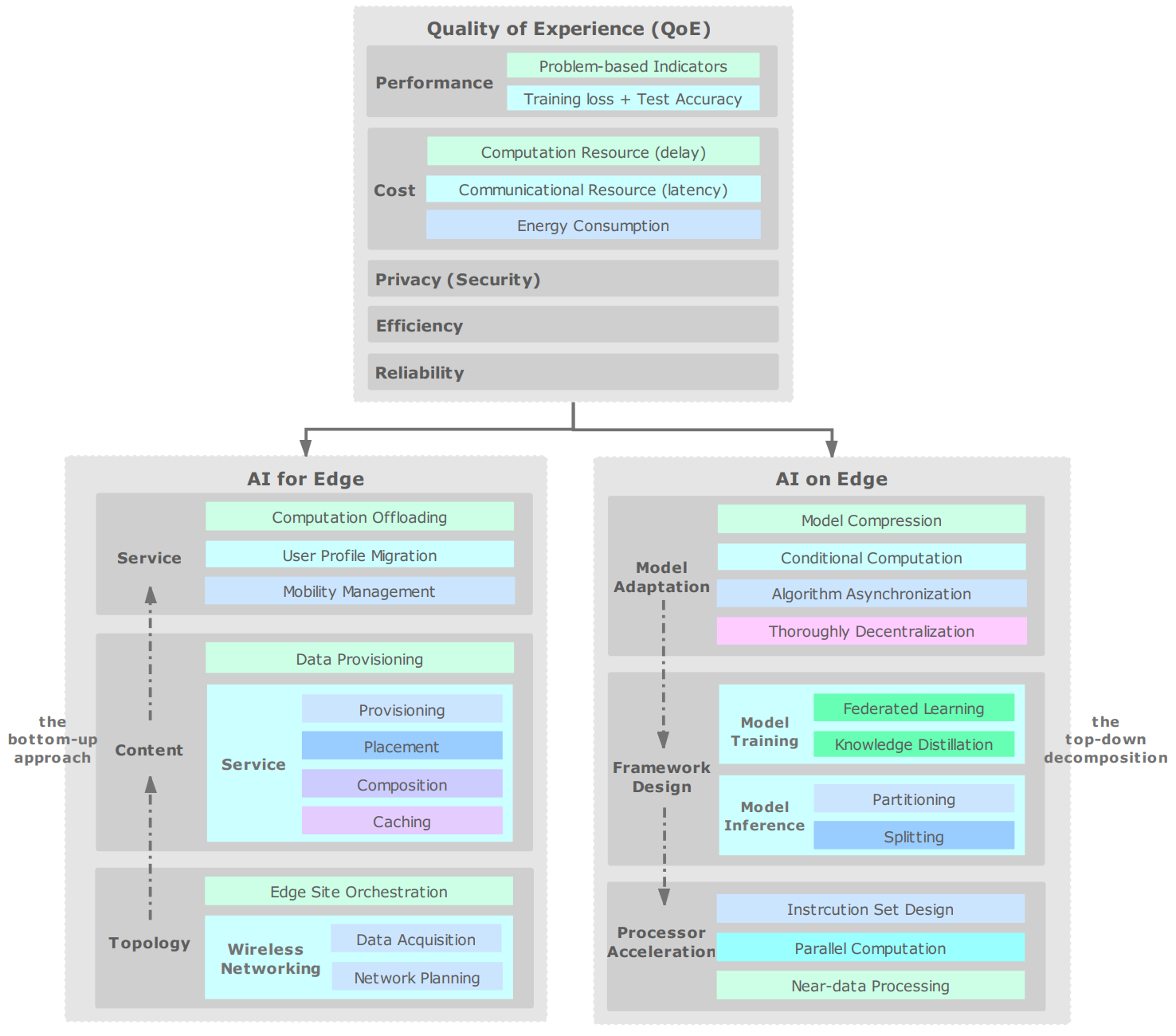
According to this published paper, we can divide Edge Intelligence into two:
- AI for Edge (IEC)
- AI on Edge (AIE)
It discusses core concepts and roadmap to potential future initiatives in Edge Intelligence.
What is Edge Intelligence?
Cloud Computing (Old way)
Devices are collectors. They gather data and send it to a central server (the Cloud) to be processed. The Cloud thinks about it and sends an answer back.
Edge Intelligence (New way)
Edge Intelligence moves that thinking power directly into the device (the "Edge").
Edge Computing + Artificial Intelligence = Edge Intelligence (Edge AI)
Giving a device its own "brain" so it can think for itself, right where it is, instead of asking a giant supercomputer far away for every decision.
45% of 40 ZB global internet data will be generated by IoT devices in 2024. - Predicted by Ericsson in 2019
By end of 2025, 90.3 ZB of data from IoT devices alone. - International Data Corporation (IDC), 2025
Research Problem
Massive Distributed Data
- Advent of 5G and widespread IoT adoption is creating massive data streams in mobile and IoT devices.
- Exabytes of global internet data traffic generated daily
Cloud Limitations
- Offloading this massive data to the cloud is becoming intractable due to:
- Network congestion
- High latency and bandwidth
- Privacy and security concerns.
Research Objectives of the paper
- Simple and clear classification of “Edge Intelligence”
- Propose taxonomy dividing field into
- AI for Edge - Intelligence-enabled Edge Computing (IEC)
- AI on Edge (AIE)
- Research Roadmap and survey state-of-the-art methods
- Open challenges & future research directions
Distinguish Edge Intelligence
AI for Edge (IEC)
- Uses AI to improve how edge computing allocate resources, make decisions, and solve constrained optimization problems.
- AI adds intelligence and optimality to edge infrastructure so the system operates more efficiently
AI on Edge (AIE)
- Running AI models (training & inference) directly on the edge devices/nodes utilizing device-edge-cloud synergy
- Extracting insights from distributed edge data while satisfying performance constraints.
Confluence of AI and Edge Computing
AI provides Edge Computing with technologies and methods
- Edge Computing faces resource allocation problems that require optimization tools.
- Stochastic Gradient Descent, statistical learning, deep learning, and reinforcement learning, can solve it by finding optimal solutions iteratively.
Edge Computing provides AI with scenarios and platforms
- IoT data has made IoE a reality. Low power required AI apps can be migrated from cloud to edge.
- AI chips GPU, TPU and NPU are integrated with intelligent mobile devices.
- Facilitate DNN (deep neural network) acceleration on resource-limited IoT devices.
Methodology = Survey + Classify + Roadmap
Conceptual survey, not experimental study
- Reviewing current literature on AI and edge computing.
- Structuring the domain into two branches: AI for Edge and AI on Edge.
- Building a research road-map covering QoE, topology, content, services, model adaptation, framework design, and hardware acceleration.
- Identifying state-of-the-art solutions and unsolved problems.
How to apply AI for edge to find optimal solutions?
- Wireless Networking
Deep Learning for wireless resource management - Service Placement and Caching
Multi-Armed Bandits (MAB) for optimal placement decisions - Computation Offloading
Q-learning and Deep Q-Networks (DQN) for offloading decisions
Conceptual Key Results
- A unified definition and division of Edge Intelligence.
- A complete research roadmap outlining how AI and edge computing reinforce each other.
- Detailed mapping of techniques, challenges, and open problems across the entire stack.
Key Learning Points
Federated Learning
A distributed training framework where devices train local models on private data and send only updates to the server, preserving privacy.
Model Compression
Techniques like quantization (reducing precision) and pruning (removing redundant connections) to fit large models onto small devices.
Possible Future Works
- Better design of learning algorithms and communication protocols.
- Decentralized and blockchain-based federated learning architectures.
- Hardware-accelerated edge inference using NPUs, TPUs architectures.
- Adaptive model-splitting and dynamic partitioning of DNNs.
Conclusion
- This article offers a succinct and effective classification of EI aka. Edge Intelligence.
- Presents a hierarchical research road-map through bottom-up and top-down decomposition IEC (AI for Edge) and AIE (AI on Edge).
- Outlines state-of-the-art and grand challenges in both IEC and AIE.
- Aims for potential future research directions for Edge Intelligence.
It is a conceptual survey paper rather than an empirical study; its roadmap is comprehensive but not an experimental validation.
This blog post is derived from my research classwork presentation of a popular paper published in IEEE Internet of Things Journal ( Volume: 7, Issue: 8, August 2020) for the graduate IoT coursework at Kathmandu University.
Source: arXiv 1909.00560v2, Authors: Deng et al. Edge Intelligence: The Confluence of Edge Computing and Artificial Intelligence